Losing one or more teeth is more than just an aesthetic concern. Missing teeth can cause the surrounding teeth to shift, contribute to jawbone loss (bone resorption), affect the temporomandibular joint (TMJ), and reduce chewing efficiency, which may impact the digestive process.
During the month of Maulid Nabi Muhammad SAW, this moment of spiritual reflection can also be an opportunity to consider a long-term investment in your health. Caring for and restoring the functions of the body entrusted to us by God, including oral health, is part of maintaining our overall quality of life.
In modern dentistry, dental implants are one of the leading options for permanent tooth replacement, closely replicating the anatomy and function of natural teeth. With proper planning and care, dental implants can provide a long-term solution for replacing missing teeth while helping preserve the jawbone structure in the affected area.
What Are Dental Implants?
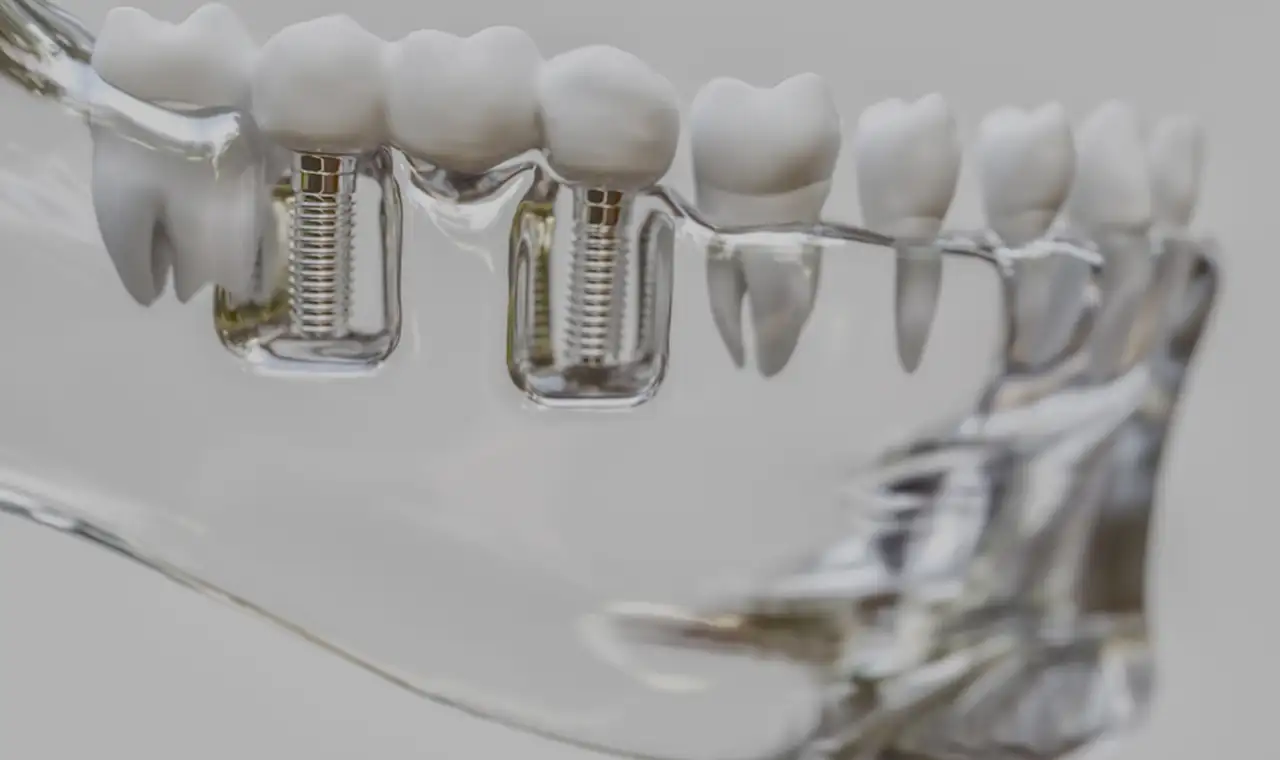
A dental implant is a medical-grade titanium screw that is surgically placed into the jawbone to replace the function of a missing tooth root.
Once placed, the implant integrates with the jawbone through a biological process known as osseointegration, creating a strong foundation to support a dental crown.
Because dental implants replace the function of the tooth root, they can provide good stability and a chewing sensation that more closely resembles natural teeth compared with some other tooth replacement options.
The Three Main Components of a Dental Implant
1. Implant Post
The implant post is a screw, typically made of titanium, a biocompatible material that is placed into the jawbone to replace the function of the natural tooth root.
2. Abutment
The abutment is a connecting component placed on top of the implant post. It serves as both a support and a connection between the implant and the dental crown.
3. Crown
The crown is the restoration placed on top of the abutment to replace the visible portion of the tooth. Its shape, size, and color are customized to match the surrounding teeth for a natural and harmonious appearance.
Dental Implants vs. Bridges and Removable Dentures
When choosing a permanent tooth replacement, there are several options to consider, including removable dentures, dental bridges, and dental implants. Each option has its own advantages and considerations.
1. Removable Dentures
With long-term use, removable dentures may experience changes in stability, which can cause them to feel loose or shift while chewing and speaking. Improperly fitting dentures may also cause gum irritation or soreness.
In addition, removable dentures do not replace the function of the tooth root and therefore do not provide direct stimulation to the jawbone. As a result, bone loss may still occur.
2. Dental Bridges
Dental bridges can restore the chewing function and aesthetics of missing teeth. However, with a conventional bridge, the healthy teeth adjacent to the gap need to be prepared or reduced to serve as abutment teeth.
3. Dental Implants
Dental implants are independently supported and do not require the reduction of healthy neighboring teeth. Because implants replace the function of the tooth root and integrate with the jawbone through osseointegration, they can help preserve bone volume in the area.
With proper planning and care, implants can also provide stability and chewing comfort that more closely resembles natural teeth.
This is one of the key advantages of dental implants compared with several other tooth replacement options.
Why Is Titanium a Preferred Material?
Titanium is one of the primary materials used in dental implants because of its excellent biocompatibility, meaning its ability to interact with body tissues without causing significant adverse reactions.
Once a titanium implant is placed in the jawbone, its surface can support the process of osseointegration, in which bone tissue grows and forms a close relationship with the implant surface.
This process allows the implant to become securely anchored within the bone and function as a strong foundation for the dental restoration placed above it.
Because of its combination of biocompatibility, strength, and ability to integrate with bone, titanium has been widely used and has become one of the standard materials in dental implantology.
Dental Implant Procedure
The dental implant procedure generally involves structured planning supported by digital imaging technology. Each case is individually evaluated to determine the most appropriate implant position, size, and placement strategy.
With proper planning and care, dental implants have a high long-term success rate, although treatment outcomes may vary from patient to patient.
1. Initial Consultation and 3D CBCT Scan
The first stage begins with a clinical examination and a 3D CBCT (Cone Beam Computed Tomography) scan.
This three-dimensional imaging technology allows the dentist to obtain detailed information about the condition and volume of the jawbone, as well as the relationship between the implant area and important anatomical structures such as nerves and the sinus cavity.
The scan data are then used as the basis for determining the position, angulation, size, and depth of implant placement in a planned and precise manner.
2. Stage 1: Implant Post Placement
The procedure is performed under local anesthesia to minimize discomfort during treatment. The dentist creates access through the gum tissue to reach the jawbone and prepares the implant site according to the treatment plan.
The titanium implant post is then placed into the jawbone at the predetermined position. Once the placement is complete, the gum tissue may be closed and allowed to enter the healing phase.
During the procedure, discomfort is generally minimized because the treatment area is anesthetized with local anesthesia. However, each individual's level of comfort and response after the procedure may vary.
3. Healing and Osseointegration
After the implant post is placed, a healing period is required to allow osseointegration to take place, forming a strong connection between the bone tissue and the implant surface.
This phase generally takes several months, depending on the condition of the bone, the implant location, and each patient's individual healing response.
When necessary, particularly for implants in the front teeth area, the dentist may provide a temporary tooth restoration during the healing period to maintain both function and aesthetics.
4. Stage 2: Abutment and Crown Placement
Once healing and osseointegration are considered adequate through clinical and radiographic examinations, the restorative phase can begin.
The abutment is placed as the connection between the implant post and the dental crown. A digital scan is then performed to accurately capture the shape and position of the teeth.
The data are used to create a crown customized according to the shape, size, color, and characteristics of the surrounding teeth.
The crown may be made from materials such as zirconia or ceramic/porcelain, and is then placed onto the abutment according to the planned restorative design.
Through a carefully planned process, from the initial examination to the final restoration, the goal of implant treatment is to provide a functional, stable, comfortable, and natural-looking replacement for the missing tooth.
Dental Implants vs. Other Tooth Replacement Options
Choosing a solution for replacing missing teeth should take into account the condition of the teeth and surrounding tissues, comfort, function, and long-term needs.
Criteria | Dental Implants | Dental Bridge | Removable Dentures |
Impact on Adjacent Teeth | None, as the implant is independently supported | With a conventional bridge, the supporting teeth need to be prepared | May use other teeth for support through clasps or a specific design |
Jawbone Stimulation | Replaces the function of the tooth root and can help preserve bone in the implant area | Does not replace the tooth root, so bone loss may still occur beneath the missing-tooth area | Does not replace the tooth root, so bone loss may still occur |
Chewing Comfort | Generally stable and may feel similar to a natural tooth after healing and adaptation | Stable and comfortable, particularly when supported by healthy abutment teeth | Can be comfortable but may move or shift during chewing and speaking |
Durability | Can last for decades with proper care and regular follow-up | Generally around 7–15 years, depending on the condition of the supporting teeth, materials, and care | Generally around 3–5 years, although this can vary |
Daily Care | Regular brushing and interdental cleaning/flossing | Brushing and special cleaning beneath the bridge | Requires regular cleaning and removal as recommended by the dentist |
Implant-Based Restorations for Multiple Missing Teeth
Dental implants are not only used to replace a single missing tooth, or a single-tooth dental implant, but can also be used as a solution for multiple missing teeth or even the loss of all teeth in one jaw.
The number of implants and the restoration design are determined based on the condition of the bone, location of the missing teeth, distribution of chewing forces, condition of the oral tissues, and each patient's individual needs.
1. All-on-4 and All-on-6 for a Full Arch
For patients who have lost all of their teeth in one jaw, the All-on-4 or All-on-6 concept allows a full-arch restoration to be supported by four or six implants, depending on the patient's condition and individual clinical treatment plan.
This concept provides an alternative to conventional full dentures by using an implant-supported full-arch restoration, which can provide improved stability and chewing function.
However, the choice between four, six, or another number of implants should be determined through a comprehensive clinical and radiographic evaluation by the dentist.
2. Implant-Supported Bridge
When several missing teeth are located next to one another, it is not always necessary to place one implant for every missing tooth.
For example, in a case involving three consecutive missing teeth, a three-unit bridge may be designed and supported by two implants strategically positioned according to the treatment plan. This allows one implant to serve as a support for more than one restorative unit.
However, the number and position of implants must still be adjusted according to the location of the missing teeth, bone condition, restoration span, and other biomechanical factors. In certain areas, particularly the posterior region, using two implants may not be the best option for every patient.
Dental implants offer considerable flexibility for rehabilitating the loss of a single tooth, multiple teeth, or all teeth in one jaw. Proper planning can allow several missing teeth to be replaced using fewer implants than the number of teeth being restored, without requiring one implant for every tooth.
Are You a Good Candidate for Dental Implants?
In general, most adults who are in good overall health may be able to undergo dental implant treatment. However, several factors need to be evaluated by the dental team before determining whether implants are the right option.
1. Bone Condition and Bone Grafting Options
Teeth that have been missing for an extended period may experience thinning of the jawbone. Dental implants require adequate bone volume and quality to achieve stable placement.
If the jawbone volume is insufficient, the dentist may consider a bone grafting procedure beforehand to rebuild the bone foundation needed to support implant placement.
2. Health Factors That May Affect Treatment
General health: Uncontrolled diabetes, severe autoimmune diseases, or a history of radiation therapy to the head and neck area require more thorough evaluation.
Smoking: Heavy smoking can interfere with blood circulation in the gums and slow down the osseointegration process. Quitting smoking during the healing period is strongly recommended.
Oral hygiene: The patient's commitment to maintaining good oral and gum hygiene is an important factor in supporting the long-term success of dental implants.
How to Care for Dental Implants
Although titanium implants cannot develop cavities, the gum and bone tissues surrounding the implant can still become inflamed if plaque accumulates. One condition that may occur is peri-implantitis.
Here are several ways to care for your dental implants:
Brush regularly: Brush your teeth at least twice a day using a soft-bristle toothbrush and a non-abrasive toothpaste.
Dental flossing or water flosser: Clean the area around the abutment and crown using implant-specific dental floss or a water flosser as recommended by your dentist.
Regular check-ups: Visit your dentist regularly for professional dental cleaning (scaling) and evaluation of the implant and surrounding tissues.
Conclusion
Replacing missing teeth is not only about restoring your smile. It is also about restoring chewing function and maintaining the health of the oral structures in the long term.
Dental implants can be one of the permanent tooth replacement options that provide stability, comfort, and an appearance similar to natural teeth. Because implants replace the function of the tooth root, they can also help preserve the jawbone in the area of the missing tooth. In addition, implants are independently supported and therefore, in many cases, do not require the reduction of healthy tooth structure in the surrounding teeth.
With proper planning and care, dental implants can serve as a long-term solution for restoring function, aesthetics, and confidence after tooth loss.
Ultimately, the most appropriate treatment option should be determined based on the condition of the teeth, gums, jawbone, and individual patient needs through an examination and consultation with a dentist.
Read More:
Dental Bridge or Dental Implant: Which Is the Best Long-Term Solution?
Dental Implant Requirements: Who Is Eligible and Who Is Not?
Root Canal Treatment: Saving an Infected Tooth Without Extraction
References
Mahendra, J., Subbiah, U., Gopalakrishnan, P., Karunanidhi, K., Rajendran, S., & Mohan, S. (2025). Decoding success: A five-year retrospective study of dental implant survival. Journal of Oral Biology and Craniofacial Research, 15(5), 948–954.
Panchal, M., Khare, S., Khamkar, P., & Suresh Bhole, K. (2022). Dental implants: A review of types, design analysis, materials, additive manufacturing methods, and future scope. Materials Today: Proceedings, 68, 1860–1867.
Takefuji, Y. (2025). Dental implant prevalence and durability: A concise review of factors influencing success and failure. Biomaterials and Biosystems, 17, 100109.
Tobias, G., Chackartchi, T., Haim, D., Mann, J., & Findler, M. (2025). Dental Implant Survival Rates: Comprehensive Insights from a Large-Scale Electronic Dental Registry. Journal of Functional Biomaterials, 16(2), 60.