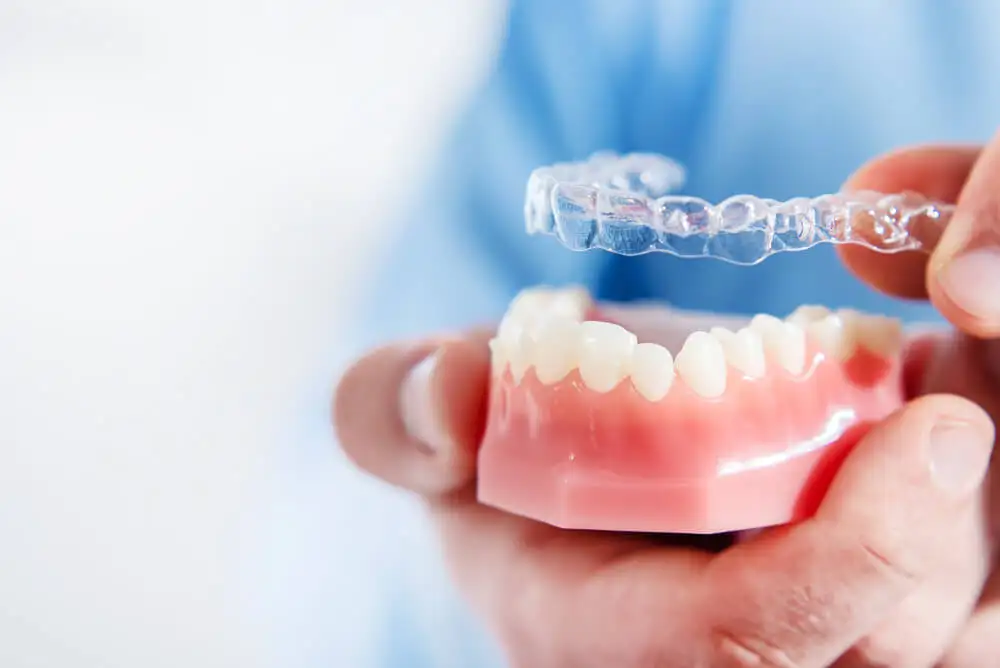
Having crooked, crowded, or spaced teeth but don't want to wear braces with brackets and wires? Clear aligners can be one of the orthodontic treatment options to consider.
Aligners are transparent trays that are custom-made based on the condition of your teeth. Each tray is worn sequentially to apply controlled pressure, gradually moving the teeth toward their planned positions.
Because of their transparent appearance, clear aligners are also known as invisible braces, or an alternative to traditional braces. However, aligners are still orthodontic appliances that require proper diagnosis, treatment planning, and monitoring by a dentist.
What Are Clear Aligners?
Clear aligners are removable orthodontic appliances in the form of transparent trays that cover the teeth. Patients wear several sets of aligners in sequence, with each tray designed to achieve specific tooth movements.
In some cases, the dentist may use attachments, which are small tooth-colored bumps placed on the surface of the teeth to help control specific tooth movements.
The success of clear aligner treatment does not depend solely on the design of the aligners. The condition of the teeth, case complexity, treatment plan, and patient compliance also play an important role in determining the final outcome.
How Does Dental Aligner Technology Work?
Clear aligner treatment has become increasingly digital. Before treatment begins, the dentist may perform an intraoral scan to obtain a three-dimensional image of the teeth and surrounding tissues.
The data is then used as part of the treatment planning process. The dentist can plan the stages of tooth movement and create a digital simulation showing the anticipated changes in tooth position.
However, this simulation should be understood as a planning tool rather than a guarantee that the final result will be exactly the same as the simulation. Actual tooth movement is influenced by each patient's biological response and compliance with aligner use.
Clear Aligners vs. Traditional Braces
Both are orthodontic treatments designed to move the teeth, but their mechanisms and user experience are different.
Appearance: Clear Aligners vs. Braces
One of the main advantages of clear aligners is their discreet appearance, making them barely noticeable when worn.
Traditional braces, on the other hand, use brackets and wires that are more visible. For this reason, aligners are often preferred by patients who want to maintain their confidence during meetings, presentations, and social activities.
Comfort and Flexibility
Clear aligners can be removed while eating and brushing your teeth. This allows patients to maintain their regular oral hygiene routine without having to clean food debris around brackets and wires.
However, their removable nature also means that patients have greater responsibility for their treatment. Aligners can only apply force to the teeth when they are being worn. The American Association of Orthodontists (AAO) generally recommends wearing aligners for around 20–22 hours per day for optimal results, unless the treating dentist provides different instructions based on the patient's condition.
Treatment Duration and Effectiveness
Treatment duration depends on the diagnosis, severity of the malocclusion, type of tooth movement required, biological response, and patient compliance.
Several studies have shown that clear aligners can be effective for various cases. However, the decision to use clear aligner treatment should still be based on the patient's diagnosis and individual needs, rather than simply the appearance of the appliance.
Who Is an Ideal Candidate for Clear Aligners?
Clear aligners for crooked teeth can be an option for various types of malocclusion, particularly cases with mild to moderate complexity.
Some conditions that may be considered for aligner treatment include:
Crowding: Teeth are overlapping or there is insufficient space within the dental arch.
Spacing or diastema: There are gaps or spaces between the teeth.
Deep bite: The upper front teeth excessively overlap the lower front teeth when biting.
Mild crossbite: One or more upper teeth are positioned behind the lower teeth.
Anterior tooth rotation: The front teeth are tilted or rotated out of position.
However, not every case of crooked or misaligned teeth can automatically be treated with aligners. The dentist needs to assess the complexity of the case and the type of tooth movement required before determining the appropriate treatment method.
When Might You Need Another Orthodontic Treatment?
Although clear aligners offer considerable flexibility, there are certain conditions in which traditional braces or a combination of orthodontic techniques may be recommended, such as:
Skeletal abnormalities: Significant discrepancies in the size or position of the upper and lower jaws.
Complex tooth movements: Cases requiring tooth extraction with significant space closure, severe molar rotation, or movement of impacted teeth.
Conditions requiring additional appliances, such as mini-implants or external orthodontic elastics, to control the direction of tooth movement.
Why Isn't Digital Simulation Alone Enough?
A 3D simulation showing digital tooth movement is only an initial treatment plan or predictive model, not a guarantee of the biological outcome. Actual tooth movement inside the mouth is influenced by the health of the supporting bone, gums, and temporomandibular joints (TMJ).
Therefore, determining whether aligners are suitable for your condition cannot be based solely on photos or digital simulations. A direct dental examination and radiographic assessment, such as panoramic and cephalometric X-rays, may be required to develop a safe and measurable treatment plan.
During the initial consultation, the dentist will perform a comprehensive evaluation to determine whether the patient is a suitable candidate.
The examination may include:
The condition of the teeth and gums.
Tooth position.
Bite relationship and pattern.
Supporting structures of the teeth.
Clinical photographs.
X-rays, such as panoramic and cephalometric images, when necessary.
Digital scanning using an intraoral scanner.
The goal is not simply to make the teeth appear straighter, but to ensure that tooth movement is planned with consideration for dental and gum health, bite function, and long-term stability.
Dental Aligner Treatment Process
Stage 1: Clinical Examination & 3D Scanning
The dentist will conduct a comprehensive evaluation of the oral cavity, followed by panoramic and cephalometric X-rays and a 3D digital scan using an intraoral scanner.
This data is used to precisely assess the teeth, roots, jawbone, and gum condition.
Stage 2: Digital Treatment Planning & Movement Simulation
The dentist will create a step-by-step treatment plan using specialized software. The 3D simulation helps the dentist and patient visualize the anticipated direction of tooth movement and the projected final result.
The digital simulation serves as a medical treatment-planning guide or predictive model. The actual outcome remains highly dependent on the biological response of the tissues and patient compliance.
Stage 3: Custom Aligner Production & Clinical Preparation
A series of aligners is custom-made according to the planned stages of tooth movement.
At this stage, the dentist may also place attachments, which are small tooth-colored composite bumps that act as points of leverage for tooth movement, or perform interproximal reduction (IPR), which involves minimally reducing the enamel between certain teeth to create additional space when necessary.
Stage 4: Wearing & Replacing Aligners Regularly
Patients wear each set of aligners according to the sequence and schedule determined by the dentist, generally replacing them every 1–2 weeks.
Wear Time: Aligners should generally be worn for 20–22 hours per day and removed only when eating, drinking hot or sugary beverages, and brushing your teeth.
Compliance: Never switch to the next set of aligners earlier than scheduled simply because the current aligner feels loose or you want to speed up the results. Tooth movement requires sufficient biological time for the supporting tissues and bone to adapt.
Stage 5: Regular Monitoring & Retention
Regular check-ups are performed to ensure that the teeth are moving according to the planned treatment and digital tracking.
Once treatment is completed and the teeth have reached their planned positions, patients need to wear retainers to help prevent the teeth from shifting back or relapsing.
Why Are Aligners Suitable for Young Professionals in Greater Jakarta?
For professionals with busy schedules filled with meetings, presentations, business trips, and social activities, clear aligners offer a combination of aesthetics and flexibility.
With clear aligners, you can:
Maintain your confidence: Their transparent appearance makes aligners discreet when communicating with clients or appearing on camera.
Enjoy flexibility and comfort: They can be easily removed when eating at restaurants or attending formal events, without the dietary restrictions associated with traditional braces.
Fit them into your routine: They are practical for those working in Jakarta's business districts, including SCBD, Kuningan, and Sudirman, as well as surrounding areas such as BSD, Gading Serpong, and Karawaci.
However, the convenience and aesthetic benefits of dental aligners cannot replace the importance of proper diagnosis and professional dental care.
Tips for Maintaining Your Clear Aligners for Optimal Results
Maintain good oral and aligner hygiene: Always brush your teeth and clean between your teeth with dental floss after eating before putting your aligners back in. Food trapped underneath the aligners can increase the risk of cavities and gum problems.
Avoid eating and drinking colored beverages while wearing aligners: Always remove your aligners when eating or drinking anything other than cool or room-temperature water. Hot beverages can alter the shape of the aligner plastic, while colored beverages such as coffee, tea, and turmeric-based drinks can cause staining.
Clean your aligners regularly: Rinse your aligners under running water and gently brush them with a soft-bristled toothbrush without abrasive toothpaste, or use specially formulated aligner cleaning tablets.
Do not skip your check-ups: If your aligner feels uncomfortable, becomes cracked, is lost, or no longer fits properly or becomes off-track, contact your dentist promptly and do not force the aligner into place on your own.
Conclusion
Clear aligners are an orthodontic treatment option that can help improve tooth alignment and bite without traditional brackets and wires. Their discreet appearance, removability during meals and oral hygiene, and flexible use make them an attractive alternative to traditional braces for many patients.
However, not every case of crooked or misaligned teeth can be treated optimally with aligners. Cases involving complex tooth movements or certain jaw structural abnormalities may require traditional braces or a combination of other treatments.
If you want to know whether clear aligners for crooked teeth are suitable for your condition, the first step is to have a dental examination and consultation. With proper diagnosis and treatment planning, clear aligner treatment can be carried out in a more controlled manner to help achieve a straighter, healthier, and more stable smile.
Read More:
References
American Association of Orthodontists. (n.d.). Clear aligners. https://aaoinfo.org/treatments/aligners/
D’Antò, V., Oliva, G., Nieri, M., Rongo, R., D’Apuzzo, F., Nucci, L., & Perillo, L. (2025). Indications and limits of clear aligner therapy: An international modified Delphi consensus study. Progress in Orthodontics, 26, Article 28. https://doi.org/10.1186/s40510-025-00575-1
Hartogsohn, C. R., & Sonnesen, L. (2025). Clear Aligner Treatment: Indications, Advantages, and Adverse Effects—A Systematic Review. Dentistry Journal, 13(1), 40. https://doi.org/10.3390/dj13010040
Lim, Z. W., & Meade, M. J. (2025). Clear aligner therapy and its effectiveness in the management of overbite and inter-arch occlusal contact: A narrative review. Seminars in Orthodontics. Advance online publication. https://doi.org/10.1053/j.sodo.2025.04.002