When a cavity is left untreated, pain that initially comes and goes can develop into more intense discomfort, potentially interfering with daily activities and sleep. In some cases, people may assume that tooth extraction is the only way to resolve the problem.
However, when a tooth can still be preserved and restored with a favorable prognosis, preserving the natural tooth is generally an important consideration in endodontic treatment. One of the options is root canal treatment.
This treatment is designed to address inflamed or infected pulp, clean and disinfect the root canal system, and seal the tooth so that it can be preserved and continue to function.
At Onyx Dental Center, Karawaci, treatment is performed with an emphasis on accurate diagnosis, procedural precision, modern technology such as dental microscopes, and patient comfort.
What Is Root Canal Treatment?
Root canal treatment is an endodontic procedure used to treat pulp that has become inflamed or infected and cannot heal on its own.
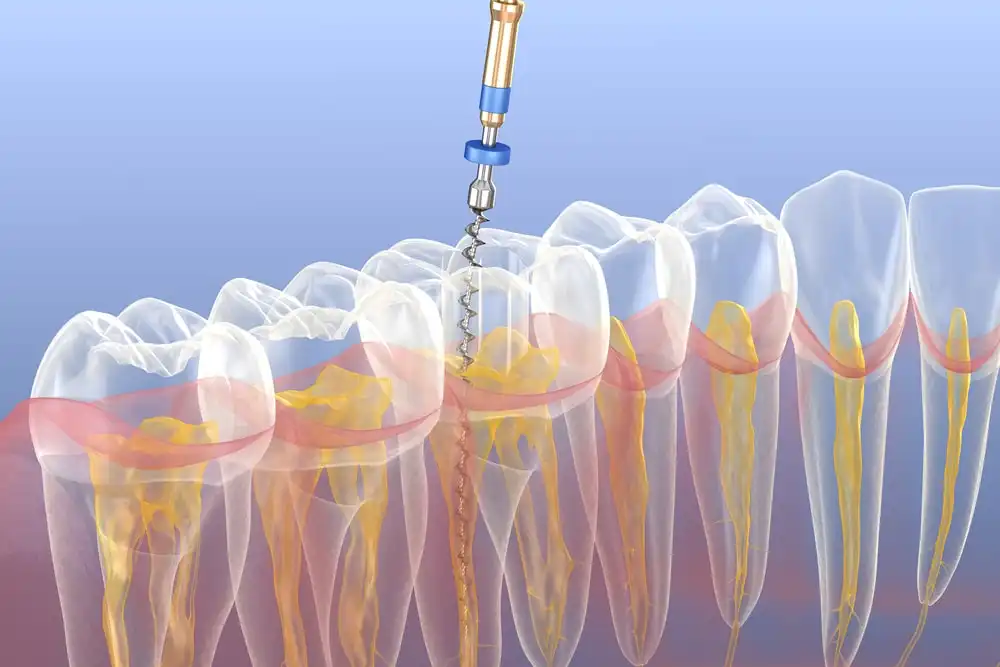
The pulp is the soft tissue inside the tooth that contains nerves, blood vessels, and connective tissue. When the pulp is severely damaged or infected, it may need to be removed. The root canal system is then cleaned, shaped, disinfected, and filled before the tooth is sealed with an appropriate restoration.
The goal is not simply to relieve pain, but to preserve the natural tooth when its condition allows for treatment and offers a favorable prognosis.
With appropriate treatment, a tooth that has undergone root canal treatment can continue to function for biting and chewing.
Understanding Tooth Anatomy and the Root Canal System
To understand why an infection may require root canal treatment, it is helpful to understand the basic structure of a tooth.
Enamel
The hard outermost layer of the tooth that protects the underlying structures from pressure, friction, and acid exposure.Dentin
The layer beneath the enamel, which has a naturally yellowish appearance and contains microscopic tubules that can transmit stimuli toward the pulp.Pulp
The soft tissue located in the center of the tooth that contains nerves and blood vessels.Root Canal
The space within the tooth's root that contains the pulp tissue and extends toward the tip of the root.
When an infection reaches the pulp and the tissue can no longer be preserved, your dentist may consider endodontic treatment to address the source of the infection while preserving the remaining healthy tooth structure.
What Conditions May Require Root Canal Treatment?
Root canal treatment may be considered when the pulp has suffered damage, inflammation, or infection that cannot be reversed. Possible causes include:
Deep tooth decay or cavities.
A cracked or fractured tooth involving the pulp.
Dental trauma.
Repeated dental procedures on the same tooth.
Leakage around an old restoration that allows bacteria to enter again.
Infection in the tissues around the root tip, including an abscess or periapical lesion.
A tooth with necrotic pulp may also require root canal treatment, particularly when infection is present in the tissues surrounding the root.
However, a “dead tooth” does not automatically mean that it needs to be extracted. A thorough clinical examination and appropriate diagnostic tests are still necessary to determine whether the tooth can be preserved and restored with a favorable prognosis.
Signs Your Tooth May Need Root Canal Treatment
Not every tooth requiring root canal treatment produces the same symptoms. In fact, a tooth with necrotic pulp may cause little or no pain.
For this reason, symptoms alone are not enough to establish a diagnosis. Some signs that should be evaluated by a dentist include:
1. Spontaneous or Persistent Tooth Pain
Pain that occurs without stimulation, discomfort when biting, or pain that lingers after consuming hot or cold foods and beverages may indicate a problem with the dental pulp.
Pain that becomes more noticeable at night can also occur in certain conditions, but it does not automatically indicate that a tooth requires root canal treatment.
2. Persistent Sensitivity to Hot or Cold
Sensitivity to hot or cold can result from various conditions, including tooth decay, dental sensitivity, cracks, or pulp-related problems.
One sign that requires attention is pain that continues even after the source of heat or cold has been removed. Your dentist may perform pulp testing along with other examinations to assess the condition of the tooth more accurately.
3. Tooth Discoloration
A tooth that becomes darker may be associated with pulp damage or previous trauma. However, discoloration alone is not sufficient to establish a diagnosis.
A dental examination is still necessary to determine the cause of the discoloration and assess the condition of the tissue inside the tooth.
4. Gum Swelling or a Pimple-Like Bump
Swelling around a tooth, pain when biting, or a small pimple-like bump on the gum that may release pus should be examined, as these signs can be associated with infection within the root canal system.
If swelling is accompanied by fever, facial swelling, difficulty opening the mouth, swallowing, or breathing, seek medical or dental attention immediately, as the infection may spread to surrounding tissues.
What Happens During a Root Canal Procedure?
Every case has a different level of complexity. The number of appointments and treatment duration can depend on the type of tooth, the number and shape of its root canals, the extent of infection, and the condition of the remaining tooth structure.
In general, the root canal procedure involves the following stages:
1. Examination and Diagnosis
Your dentist will evaluate your symptoms and the condition of the tooth through a visual examination, percussion, sensitivity testing, examination of the surrounding tissues, and dental X-rays when necessary.
This stage is important for identifying the source of the problem, evaluating the tissues surrounding the root, and determining whether the tooth can still be preserved.
2. Local Anesthesia and Tooth Isolation
The treatment area is numbed with local anesthesia to help ensure a comfortable procedure.
The tooth is then isolated using a rubber dam, a sheet of dental-grade rubber that helps keep the treatment area clean and prevents contamination from saliva during the procedure.
3. Creating Access and Removing the Pulp Tissue
The dentist creates a small access opening in the crown of the tooth to reach the pulp chamber.
Damaged or infected pulp tissue is then removed using endodontic instruments designed to work precisely within the tooth's narrow internal spaces.
4. Cleaning and Shaping the Root Canals
The root canal system is cleaned and shaped using endodontic instruments, including rotary files when appropriate for the case.
This process is accompanied by irrigation with disinfecting solutions to help reduce microorganisms and clean the complex spaces within the root canal system.
5. Filling and Sealing the Root Canals
Once the root canals have been cleaned and prepared, the space is filled with materials such as gutta-percha and sealer to help seal the root canal system.
An effective seal helps reduce the possibility of bacteria re-entering the root canal system.
6. Final Restoration
After root canal treatment, the tooth requires an appropriate restoration to protect the remaining tooth structure.
For certain teeth, particularly those with significant loss of tooth structure, your dentist may recommend a dental crown to help protect the tooth from chewing forces and the risk of fracture.
Not every tooth that undergoes root canal treatment automatically requires a crown. The appropriate restoration is determined based on the amount of remaining tooth structure, the tooth's position, functional load, and other clinical factors.
Is Root Canal Treatment Painful?
Fear of dental pain is one of the reasons some patients delay treatment.
With local anesthesia and modern treatment techniques, root canal treatment can generally be performed comfortably. During the procedure, patients may feel pressure, vibration, or other sensations, but significant pain should not be expected.
In fact, one of the primary goals of treatment is to address the source of pain caused by inflamed or infected pulp tissue.
After treatment, some patients may experience mild sensitivity or discomfort for several days, particularly when biting. This can occur as a response of the surrounding tissues to the treatment and can usually be managed according to the dentist's instructions.
If the pain becomes increasingly severe, persists for an extended period, or is accompanied by swelling, you should consult your dentist again.
Root Canal Treatment at Onyx Dental Center
For patients living in Karawaci, Tangerang, Gading Serpong, BSD, and West Jakarta, Onyx Dental Center offers endodontic care with an approach focused on precision and comfort.
The root canal system is extremely small and can have complex anatomy and branching patterns. Clear visualization can therefore help the dentist perform treatment with greater accuracy.
At Onyx Dental Center, dental microscopes provide magnification of the treatment area, allowing dentists to visualize structures and canals that may be difficult to see with the naked eye. This technology supports a more controlled and precise approach to treatment.
During the initial visit, your dentist will examine the tooth to determine its condition, the extent of damage, and whether it has a favorable prognosis for preservation through root canal treatment.
Root Canal Treatment: Myths and Facts
Myth: Root Canal Treatment Is Always Very Painful
Fact: With local anesthesia and modern techniques, treatment can generally be performed comfortably. Patients may experience sensations such as pressure or vibration during the procedure, while mild sensitivity may occur afterward.
Myth: If a Tooth Is Dead, It Must Be Extracted
Fact: Not necessarily. A tooth with necrotic pulp may still be considered for root canal treatment if its structure can be preserved and restored with a favorable prognosis.
Myth: Root Canal Treatment Is Simply About Removing the Tooth's Nerve
Fact: The treatment involves a series of carefully controlled steps, from creating access and removing damaged pulp tissue to cleaning and disinfecting the root canal system, filling and sealing it, and placing an appropriate restoration.
Myth: A Tooth That Has Undergone Root Canal Treatment Will Not Last Long
Fact: The prognosis of a root-treated tooth depends on various factors, including its initial condition, the quality of the treatment, the final restoration, oral hygiene, and functional load.
With appropriate endodontic treatment and restoration, the natural tooth can be preserved and continue to function for the long term.
Conclusion
Root canal treatment is one of the treatment options available for addressing pulp infection or damage while preserving a natural tooth that can still be restored.
With an accurate diagnosis, thorough cleaning and disinfection of the root canal system, and an appropriate final restoration, the goal is not only to address the infection but also to preserve the tooth's function for the long term.
So, if you experience a deep cavity, persistent tooth pain, or swelling around a tooth, do not immediately assume that extraction is your only option. Consult the dental team at Onyx Dental Center, Karawaci, Tangerang, to understand which treatment option is most appropriate for your condition.
References
Guimarães, L. S., Silva, E. A. B. D., Hespanhol, F. G., Tavares, M. L. C. D., Antunes, L. A. A., & Antunes, L. S. (2025). Impact of root canal treatment on oral health-related quality of life: a prospective cohort study. Brazilian Oral Research, 39, e126. https://doi.org/10.1590/1807-3107bor-2025.vol39.126
ScienceDirect. (2026). Root Canal. ScienceDirect Topics; Elsevier. https://www.sciencedirect.com/topics/medicine-and-dentistry/root-canal