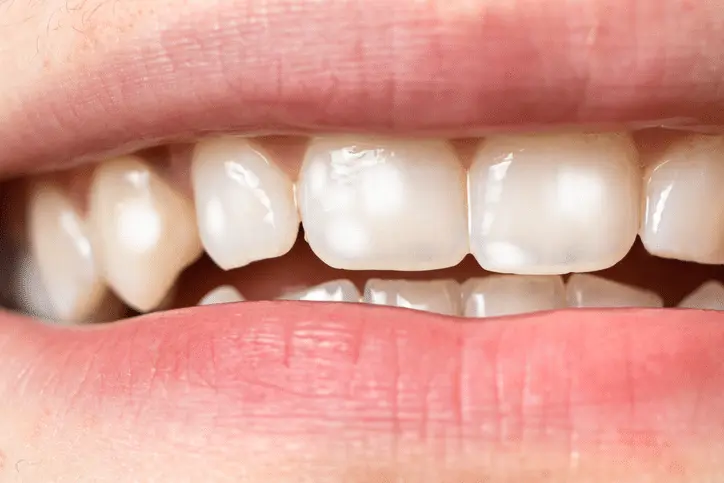
Why Do White Spots Appear on Teeth?
White spots on teeth, medically referred to as white spot lesions, occur when the enamel layer loses minerals (demineralization). Visually, the affected area appears chalky or more opaque compared to the surrounding healthy tooth structure.
White spot lesions are not merely an aesthetic concern. They represent an early stage of the caries process and indicate microscopic structural changes within the enamel. The most common causes include:
Post-Orthodontic Decalcification
After orthodontic treatment with braces, plaque accumulation around brackets can lead to mineral loss in the enamel. Once the braces are removed, white spots may become visible and appear more pronounced against the surrounding tooth surface. This is a frequent aesthetic concern among orthodontic patients.
Mild Fluorosis
Excessive fluoride exposure during tooth development can alter enamel formation. Mild to moderate fluorosis often results in persistent white patches that remain visible into adulthood.
Why Bleaching Is Not Always Effective for White Spot Lesions
Many patients attempt teeth whitening to reduce the appearance of white spots. However, bleaching works by brightening the entire tooth surface. As a result:
Healthy enamel becomes lighter
The white spot lesion remains opaque
The contrast may become even more noticeable
Since the primary issue in white spot lesions involves enamel structure rather than overall color, treatment should focus on stabilizing and improving the enamel rather than simply whitening the tooth.
Icon Resin Infiltration: A Modern Solution Without Drilling or Injections
One of the most advanced minimally invasive approaches in modern dentistry is Icon Resin Infiltration.
This technique is based on a precise scientific principle. Areas affected by white spot lesions contain microscopic pores due to mineral loss. A specially formulated liquid resin is applied and penetrates these pores. Once cured, the resin:
Fills the microscopic spaces within the enamel
Helps halt the progression of demineralization
Matches the light refractive index of healthy enamel
Because light is no longer scattered differently, the white spot visually blends with the surrounding tooth surface.
The Icon resin infiltration procedure:
Does not require drilling
Does not require local anesthesia
Is completed in a single visit
Is minimally invasive
This makes Icon Resin Infiltration a modern and conservative solution for white spot lesions caused by braces or mild fluorosis.
Advantages of Icon Resin Infiltration Compared to Other Treatments
Compared to conventional restorative procedures, Icon Resin Infiltration offers several important benefits:
Preservation of natural tooth structure
Immediate aesthetic improvement
Stabilization of early enamel lesions
Minimal discomfort
This approach aligns with contemporary dental principles, prioritizing the preservation of healthy tooth structure whenever possible.
Who Is Suitable For This Treatment?
Icon Resin Infiltration is ideal for:
White spot lesions following orthodontic treatment
Mild to moderate fluorosis
Early-stage caries lesions
However, not all white spots share the same underlying cause. A thorough clinical examination is essential to determine whether resin infiltration is the most appropriate treatment option.
Conclusion
White spots on teeth, or white spot lesions, are often considered purely aesthetic concerns, yet they may indicate early enamel demineralization. Conventional bleaching treatments do not always provide optimal results because they do not address the underlying enamel structure.
With Icon Resin Infiltration, white spots can be visually blended without drilling or invasive procedures. This approach not only enhances smile aesthetics but also supports the stabilization of enamel integrity.
Learn more about Onyx Dental Center Treatments:
At Onyx Dental Center, every treatment is guided by precision and minimally invasive principles, because we believe a healthy smile begins with preserving natural tooth structure.
References
El Meligy, O. A. E. S., Alamoudi, N. M., Eldin Ibrahim, S. T., Felemban, O. M., & Al-Tuwirqi, A. A. (2021). Effect of resin infiltration application on early proximal caries lesions in vitro. Journal of Dental Sciences, 16(1), 296–303. https://doi.org/10.1016/j.jds.2020.04.005
International Journal of Clinical Dentistry. (2022). Resin infiltration in management of white spot lesions. Retrieved from https://medicopublication.com/index.php/ijocd/article/download/18813/16321/36614
ScienceDirect. (2025). Resin infiltration for enamel white spot lesions. Retrieved from https://www.sciencedirect.com/science/article/pii/S0020653925044442