Losing one or more teeth affects more than just your appearance. It can also interfere with chewing, speaking, and the health of the surrounding teeth. As a result, many people seek a permanent tooth replacement that feels more secure and stable than removable dentures.
Does every permanent tooth replacement involve dental implants? The answer is no. Today, there are several fixed restorative options for replacing missing teeth, with the two most common being dental bridges and dental implants. Each option has its own indications, benefits, and limitations, so the best choice depends on your individual oral condition.
If you're considering a permanent tooth replacement, a comprehensive dental examination is the first step toward determining the most appropriate treatment.
What Is a Permanent Tooth Replacement?
A permanent tooth replacement, also known as a fixed dental prosthesis, is a restoration that is permanently attached by a dentist and cannot be removed by the patient.
Its primary goals are to:
Restore chewing function
Improve speech
Enhance the appearance of your smile
Prevent adjacent teeth from shifting into the empty space
Maintain a balanced bite
Unlike removable dentures, permanent restorations are securely attached to either neighboring teeth or dental implants, providing greater comfort and stability during daily activities.
Permanent Tooth Replacement Options
Dental Bridge
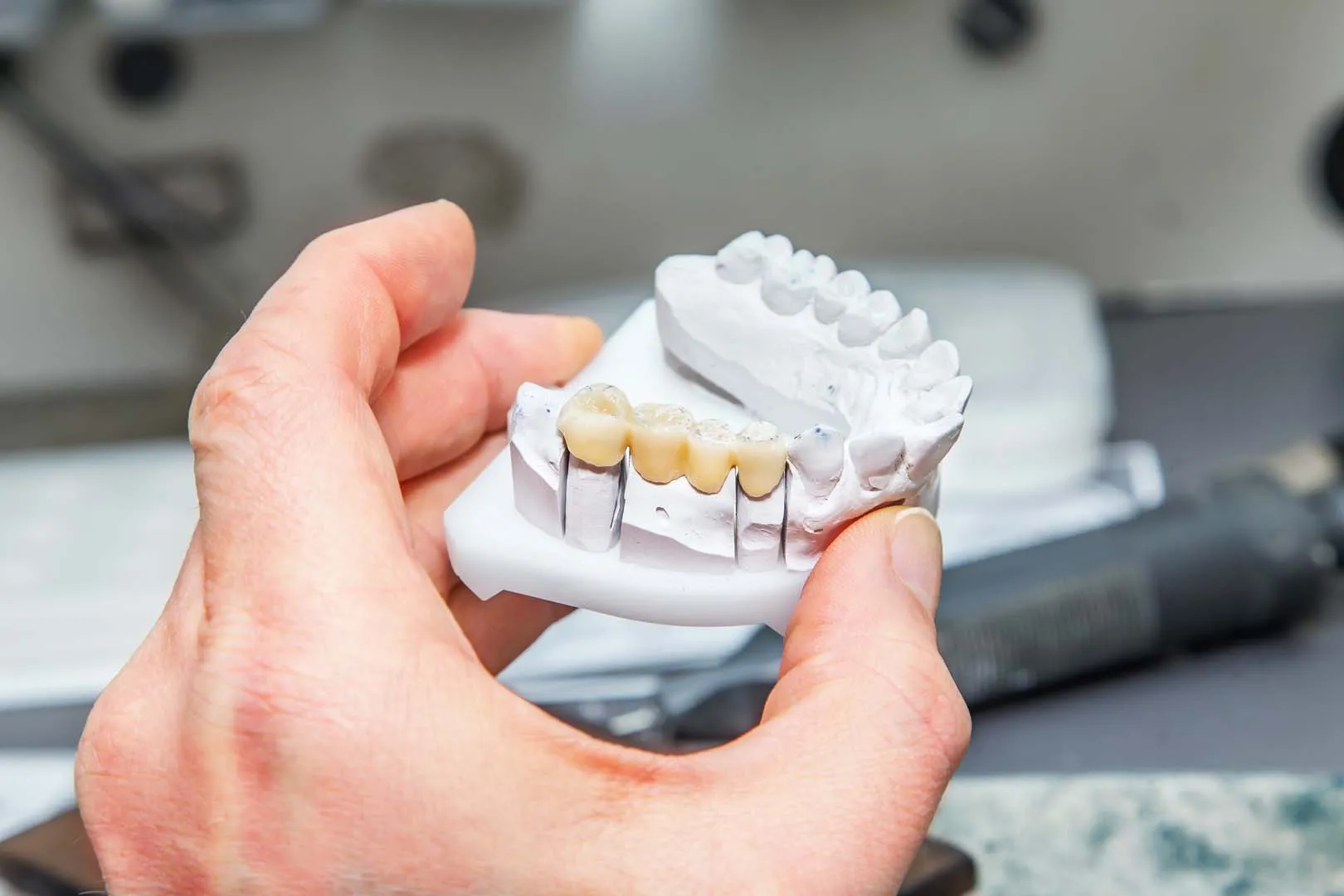
A dental bridge is a fixed restoration used to replace one or more missing teeth by utilizing the natural teeth adjacent to the gap as supporting teeth (abutments).
A dental bridge typically consists of:
Crowns placed on the supporting teeth
One or more artificial replacement teeth (pontics)
Connectors that join the crowns and pontics together
A dental bridge may be recommended when:
The neighboring teeth are healthy and strong enough to support the restoration.
The patient prefers not to undergo dental implant treatment.
The jawbone is not suitable for implant placement, and bone augmentation is not planned.
Advantages of a dental bridge include a relatively shorter treatment time and no need for implant surgery. However, preparing a bridge generally requires reshaping healthy adjacent teeth.
Dental Implant
A dental implant is an artificial tooth root made of titanium or titanium alloy that is surgically placed into the jawbone to replace a missing tooth root. After the implant integrates with the surrounding bone through a process called osseointegration, an abutment and a custom-made dental crown are attached to restore the missing tooth.
Benefits of dental implants include:
No need to reshape adjacent teeth
Helps preserve the jawbone after tooth loss
Excellent stability while chewing
Highly natural-looking results when properly planned
Long-term durability with proper maintenance
However, dental implants require an evaluation of jawbone quality, overall health, and a longer healing period compared with a dental bridge.
Dental Crown as Part of Fixed Restorations
Many people assume that a dental crown is itself a permanent tooth replacement. In reality, a dental crown is not used to replace a missing tooth.
Instead, it is designed to restore and protect teeth that still have healthy roots, such as teeth:
After root canal treatment
With extensive decay
That are cracked or fractured
Serving as the visible crown placed on top of a dental implant
Therefore, while a dental crown is often part of a permanent restoration, it does not replace a missing tooth on its own.
Dental Bridge vs. Dental Implant
Dental Bridge | Dental Implant |
Supported by adjacent natural teeth | Supported by an implant placed in the jawbone |
Requires preparation of neighboring teeth | Does not affect adjacent teeth |
Typically completed in a shorter time | Requires a healing phase before the final crown is placed |
No implant surgery required | Requires implant placement surgery |
Suitable when adjacent teeth are healthy and strong | Suitable when sufficient jawbone and overall health conditions are present |
Neither option is universally better. Your dentist will recommend the most appropriate treatment based on your individual clinical condition.
Who Is a Good Candidate for a Permanent Tooth Replacement?
Permanent tooth replacement may be suitable for patients who:
Have lost one or more permanent teeth
Want a stable and comfortable long-term solution
Have healthy gums or have completed periodontal treatment if needed
Maintain good oral hygiene
Are committed to regular dental check-ups
For patients considering dental implants, the dentist will also evaluate jawbone quantity and quality, overall health, and risk factors such as smoking or uncontrolled diabetes. A comprehensive examination is essential to ensure the implant procedure is appropriate and has a favorable long-term prognosis.
Consultation and Examination Process
Before recommending the most suitable treatment, your dentist will perform several evaluations, including:
Reviewing your dental and medical history
Examining your teeth and gums
Assessing your bite (occlusion)
Taking dental X-rays, such as panoramic radiographs or CBCT scans when necessary, particularly for implant cases
Discussing treatment options based on your clinical condition and expectations
At Onyx Dental Center Karawaci, every treatment plan is carefully designed to achieve long-term function, comfort, and aesthetics.
Caring for Your Permanent Tooth Replacement
The long-term success of a restoration depends not only on the treatment itself but also on daily care.
Recommended habits include:
Brush your teeth twice daily using fluoride toothpaste.
Clean between your teeth with dental floss or interdental brushes.
Attend regular dental check-ups as recommended.
Avoid chewing hard objects such as ice or using your teeth to open packages.
Wear a night guard if you grind your teeth (bruxism), as advised by your dentist.
With proper care, both dental bridges and dental implants can provide reliable function for many years.
When Should You Visit a Dental Clinic?
Schedule a consultation if you experience any of the following:
One or more missing permanent teeth
Difficulty chewing due to tooth loss
Adjacent teeth beginning to shift into the empty space
You want a more stable solution than removable dentures
You would like to know whether a dental bridge or a dental implant is the better option for your condition
At Onyx Dental Center Karawaci, your dentist will perform a comprehensive examination to determine the most appropriate restorative treatment based on your teeth, gums, jawbone, and both your functional and aesthetic needs. Early consultation can help prevent further tooth movement and preserve proper chewing function.
Conclusion
Permanent tooth replacement is an effective solution for restoring chewing function, improving smile aesthetics, and enhancing comfort after tooth loss. The two primary treatment options are dental bridges and dental implants, each offering distinct benefits, indications, and considerations. Meanwhile, dental crowns are used to restore and protect existing teeth or serve as the visible restoration on top of a dental implant, rather than replacing a missing tooth by themselves.
Because every patient has unique dental, gum, and jawbone conditions, the ideal treatment should always be determined through a comprehensive dental examination. If you've lost a tooth and are looking for a stable, comfortable, and natural-looking solution, consult the team at Onyx Dental Center Karawaci to find the treatment option that best meets your needs.
References
Geiballa, G. H., Abubakr, N. H., & Ibrahim, Y. E. (2016). Patients' satisfaction and maintenance of fixed partial denture. European journal of dentistry, 10(2), 250–253. https://doi.org/10.4103/1305-7456.178313
Hebel, K., Gajjar, R., & Hofstede, T. (2000). Bridge vs. implant-supported restoration for single-tooth replacement. Journal of the Canadian Dental Association, 66(8), 435–438. https://www.cda-adc.ca/jcda/vol-66/issue-8/435.pdf
Hill, S., Bailey, S., & Hamson, A. (2023, March). Dental bridges for partial tooth loss (CADTH Health Technology Review). Canadian Agency for Drugs and Technologies in Health. https://www.ncbi.nlm.nih.gov/books/NBK596304/