What Are Inlays and Onlays?
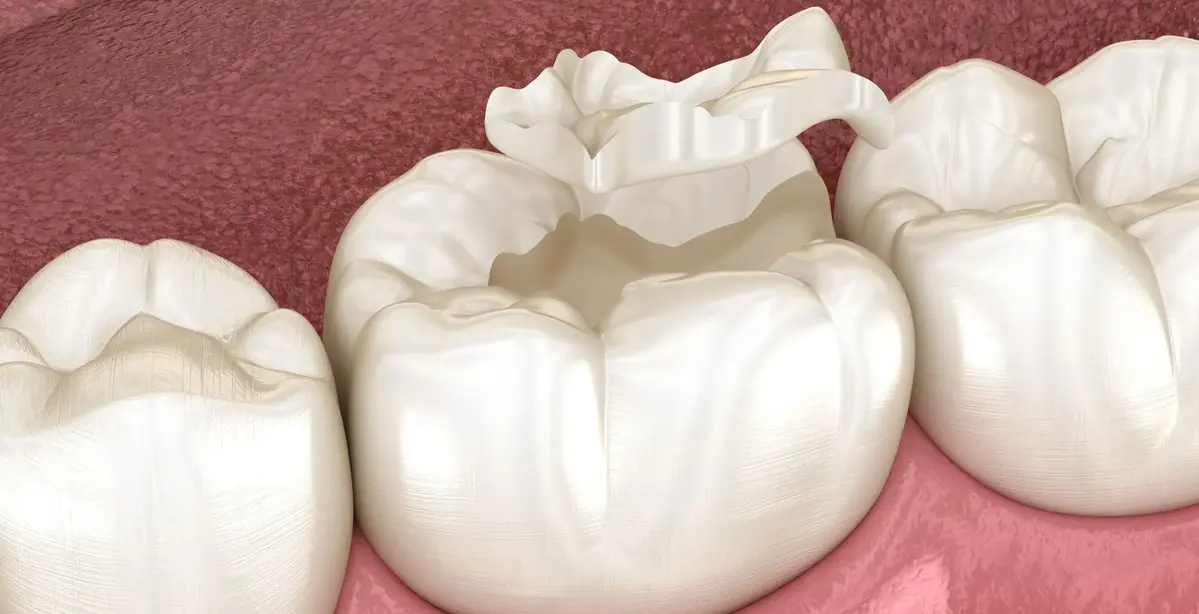
Inlays and onlays are types of indirect restorations fabricated with precision in a dental laboratory to replace tooth structure lost due to decay or fracture.
Technically:
Inlays are used to fill the inner portion of the chewing surface without covering the cusps.
Onlays cover one or more cusps and are often referred to as partial crowns because they provide wider coverage than inlays while remaining more conservative than full crowns.
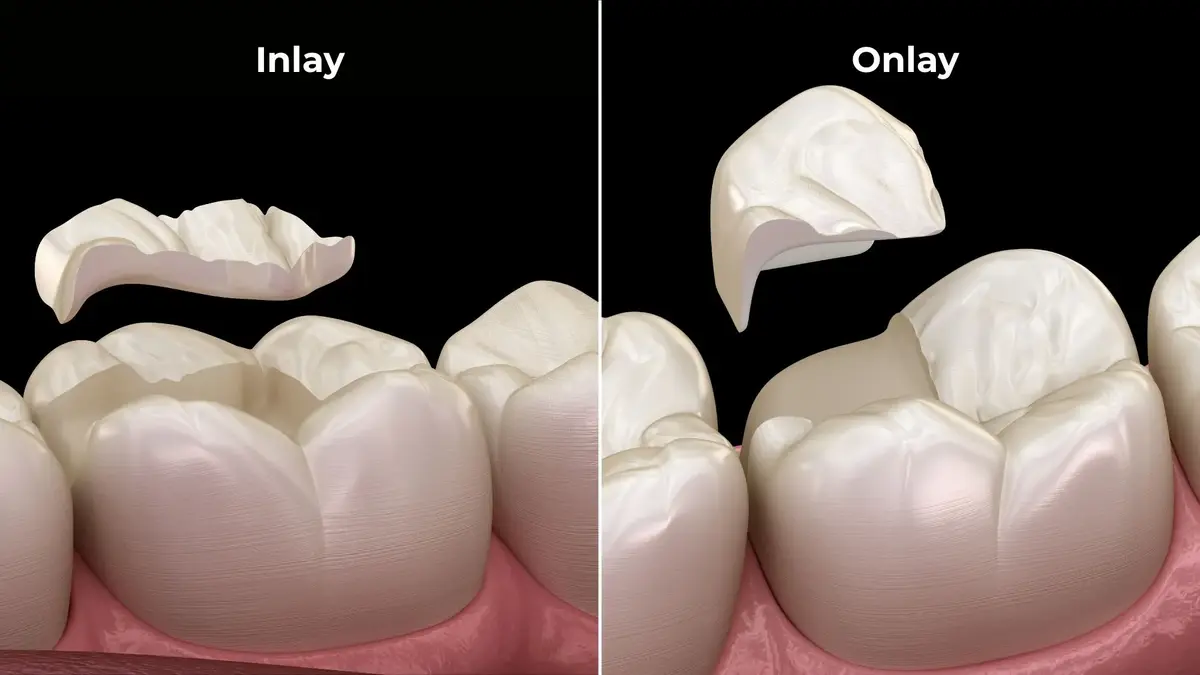
Both are designed to restore anatomical form, chewing function, and aesthetics in a harmonious way—particularly for posterior teeth that endure significant biting forces.
Why Not a Regular Composite Filling?
Direct composite fillings are practical and can usually be completed in a single visit. However, scientifically, nearly all resin composites undergo polymerization shrinkage as they harden.
In small cavities, this effect is often minimal. But in moderate to large defects, shrinkage may lead to:
Microleakage between the restoration and the tooth
Post-treatment sensitivity
Risk of secondary decay beneath the filling
Additional stress on weakened tooth walls
In contrast, inlays and onlays are fabricated in a controlled laboratory environment, meaning the material is fully cured before placement. Once bonded to the tooth, their shape and volume are stable.
With modern adhesive techniques, these restorations can restore approximately 70–90% of the tooth’s structural strength, particularly when weakened cusps are reinforced.
For moderate to large cavities, this approach offers a stronger, more precise, and more durable solution than direct fillings.
Why Not Go Straight to a Dental Crown?
A dental crown is typically indicated when tooth damage is extensive. However, crown preparation requires circumferential reduction, including removal of healthy tooth structure.
Inlays and onlays follow the principles of minimally invasive dentistry and biomimetic dentistry, which aim to:
Remove only infected tissue
Preserve as much natural tooth structure as possible
Reinforce the remaining tooth without aggressive preparation
In other words, inlays and onlays sit between direct fillings and full crowns—providing a solution that is both conservative and premium.
Aesthetics and Material Options
Inlays and onlays are commonly made from:
Dental ceramic or porcelain
Zirconia
Metal
Laboratory-fabricated composite resin
Advantages include:
Natural color that closely resembles tooth enamel (especially porcelain)
Excellent color stability, with minimal risk of discoloration
Smooth and precise surfaces for comfortable chewing
High resistance to biting forces, particularly with zirconia and metal
Long-term durability averaging 10–15 years or more, depending on material, technique, and patient care
From an aesthetic perspective, porcelain offers the most natural translucency, closely mimicking enamel.
Zirconia excels in strength, making it ideal for patients with heavy biting forces.
Metal restorations are known for exceptional durability and precision, though they are not aesthetic.
Overall, compared to conventional fillings, inlays and onlays provide superior stability in form, color, and strength—particularly for posterior teeth with significant structural loss.
Ideal Indications for Inlays and Onlays
This treatment is recommended for:
Moderate to large cavities
Weakened cusps
Partial fractures of posterior teeth
Replacement of large existing fillings
Patients with high aesthetic expectations
However, when minimal tooth structure remains, a full dental crown may still be the more appropriate option.
Conclusion
Inlays and onlays represent a modern restorative solution that balances strength, precision, and conservation of natural tooth structure.
When a conventional filling feels insufficient and a crown seems too aggressive, inlays or onlays offer an elegant and measured alternative.
Because in contemporary dentistry, restoration is not merely about covering damage—it is about preserving the integrity of the natural tooth for the long term.
References
Inlays and onlays. (n.d.). In ScienceDirect Topics. Retrieved from https://www.sciencedirect.com/topics/medicine-and-dentistry/inlays-and-onlays
International Journal of Community Medicine and Public Health. (2024). Long-term success of inlay and onlay procedures in dental repairs. International Journal of Community Medicine and Public Health, 11(10). https://doi.org/10.18203/2394-6040.ijcmph20242688
Mandal, N. B., Kumari, A., Baldev, K. C., Sarangi, P., Chauhan, R., Rajesh, D., & Tiwari, H. D. (2022). A clinical evaluation of onlay and inlay in posterior ceramic restorations: An original study. Journal of Pharmacy & Bioallied Sciences, 14(Suppl 1), S310–S312. https://doi.org/10.4103/jpbs.jpbs_776_21