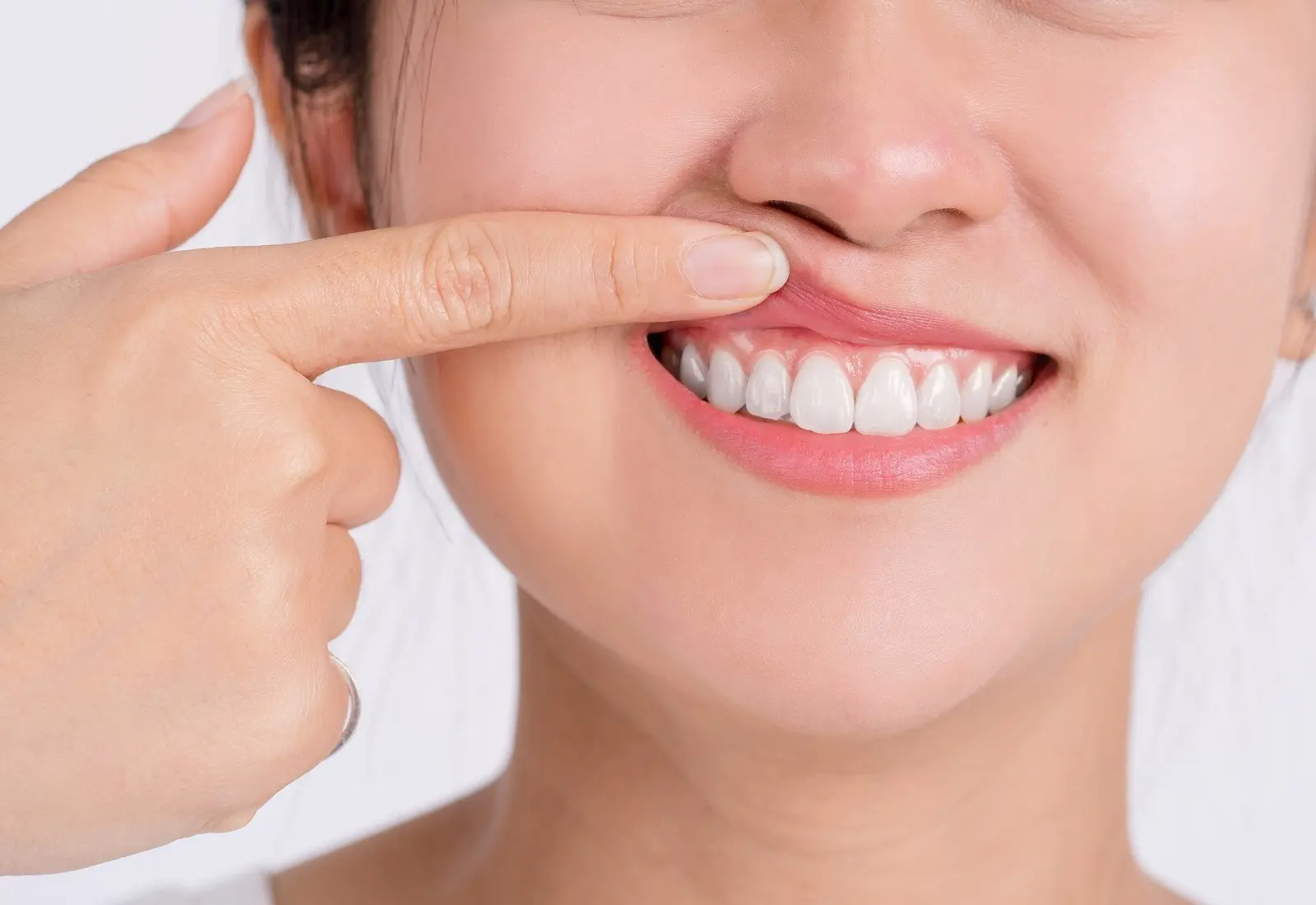
What Is a Gummy Smile?
A gummy smile is a condition where the gums appear more prominent when smiling. For some people, it may not be a health issue, but it can affect confidence—especially in photos or during conversations.
The good news is, a gummy smile has various solution options. Before choosing a treatment, it’s important to understand the cause and which option suits your condition best.
Common Causes of Gummy Smile
A gummy smile can result from one or a combination of several factors. Each cause requires a different approach to treatment.
Altered Passive Eruption (APE)
This condition occurs when the natural movement of the gums after tooth eruption does not happen properly. As a result, the gums cover more of the tooth crown than they should.
Characteristics of APE:
Teeth appear shorter than normal
Gums look “thick” and cover excessive parts of the crown
Gums appear prominent when smiling even though the teeth are in normal position
The issue isn’t small teeth—it’s the excess gum tissue covering them. Therefore, reshaping or removing the extra gum tissue becomes the main solution.
Solutions:
Laser gingivectomy: precisely removes excess gum tissue using laser technology.
Crown lengthening: adjusts gum and bone levels when needed to achieve ideal gum–tooth proportions.
Hyperactive Upper Lip Muscles
In some individuals, the upper lip muscles are more active and stronger than usual. This causes the upper lip to lift too high when smiling, exposing more gum area.
Characteristics of a hyperactive lip:
Lips look normal when relaxed
Upper lip lifts excessively when smiling
Tooth shape is normal, but gums remain visible
In this case, the problem is the lip movement—not the gums or teeth.
Solutions:
Botox: relaxes upper lip muscles for a more controlled movement.
Lip repositioning: a more permanent option to limit excessive upward lip movement.
Naturally Short Upper Lip
Some people naturally have a shorter upper lip, making it unable to fully cover the gums.
Characteristics of a short upper lip:
When relaxed, there is noticeable space between the lip and front teeth
Gums show immediately when smiling, even without strong muscle activity
No excess gum tissue—the lip simply cannot cover the gum area
The issue is the lip length, not the gum or bone structure.
Solution:
Lip repositioning: helps create a “lengthened” effect so the lips cover more gum when smiling.
Vertical Maxillary Excess (VME)
Also known as excessive vertical growth of the upper jaw. This is a more complex cause because it involves facial bone development.
Characteristics of VME:
Midface appears longer
Significant gum display while smiling
Often associated with mild open bite
Lips may appear “incompetent” at rest due to long vertical distance
This condition is usually genetic and affects overall facial proportions.
Solution:
Orthognathic surgery: adjusts the position and height of the upper jaw. Recommended for moderate to severe cases and offers permanent, proportional results.
Proclined (Forward-Inclined) Upper Teeth
When the upper front teeth tilt forward, the lip has to move higher to accomodate the tooth position, making gums more visible during a smile.
Characteristics of proclined teeth:
Front teeth appear forward or protruded
More gum show in the central smile area
Facial profile looks slightly protruded
This issue is related to tooth position, not the gums or lips.
Solutions:
Orthodontic treatment (braces): moves the teeth back into proper alignment
In some cases, minor laser gingivectomy may be combined for optimal aesthetics
Understanding the cause of your gummy smile is key to ensuring the treatment is effective.
When Should You Consult a Dentist?
A consultation is recommended if you:
Are unsure what's causing your gummy smile
Want a more aesthetic and proportional smile
Need detailed facial and lip proportion analysis
Prefer a safe, comfortable, and precise treatment
Dentists understand gum anatomy deeply and can explain your condition clearly, ensuring your treatment is both safe and aesthetically pleasing.
Conclusion
A gummy smile can arise from various factors—from incomplete tooth eruption to hyperactive lip muscles. Because each patient has different underlying causes, the treatment must be personalized.
With proper assessment by an experienced dentist or periodontist, you can achieve a more proportional, natural-looking smile that enhances your confidence.
References
Kadam D. (2024). Correction of Gummy Smile: An Essential Procedure in Facial Aesthetics. Indian Journal of Plastic Surgery, 57(6), 523–524.
Maleki, M., Huang, B., Mendes, V. C., Caminiti, M. F., & Finer, Y. (2024). A Systematic Review and Meta-Analysis Comparing Surgical and Nonsurgical Treatments for Excessive Gingival Display. Dentistry Journal, 12(6), 154.
Venugopal, A., Manzano, P., Ahmed, F., Vaiid, N., & Bowman, S. J. (2023). Gummy Smiles: Etiologies, Diagnoses & Formulating a Clinically Effective Treatment Protocol. Seminars in Orthodontics.