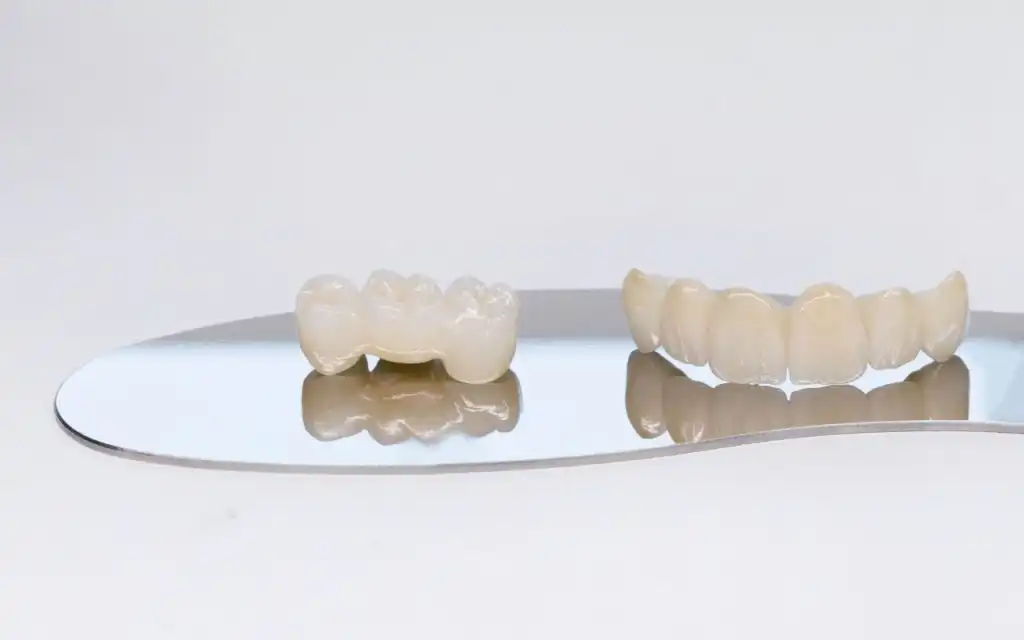
Losing one or several teeth can occur due to severe tooth decay, trauma, or gum disease. Although often seen merely as an aesthetic issue, missing teeth can also affect the overall function and health of the oral cavity.
Leaving a gap unaddressed for too long can cause adjacent teeth to shift or tilt into the empty space. In certain cases, tooth loss can also lead to a loss of jawbone volume in that specific area.
Therefore, replacing missing teeth is not only aimed at restoring the appearance of your smile, but also at helping to restore chewing function and maintaining tooth alignment within the oral cavity.
One option worth considering is permanent dentures, or fixed dental prostheses. Unlike removable dentures, these restorations are permanently fixed using natural teeth as anchors or dental implants as their foundation.
At Onyx Dental Center, Karawaci, restoration choices are tailored to the condition of each patient's teeth, gums, jawbone, functional needs, and aesthetic goals.
What Are Permanent Dentures?
Permanent dentures are restorations used to replace missing teeth that are fixed permanently inside the oral cavity. In dentistry, these restorations fall under the category of fixed dental prostheses.
Unlike removable dentures that can be taken out and put back in by the patient, fixed dental prostheses are not designed to be removed independently during daily use.
The two most common options are:
Dental implants, which replace the root of the tooth with an implant placed inside the jawbone to support a dental crown.
Dental bridges, which replace missing teeth with prosthetic teeth supported by adjacent natural teeth or implants.
The best choice is not always the same for every patient. Dentists must evaluate the condition of the teeth, gums, jawbone, the number of missing teeth, and functional and aesthetic requirements before deciding on the appropriate restoration.
Who Should Consider Permanent Dentures?
Permanent dentures can be an option for patients who experience:
Loss of one or several teeth
Tooth loss in either the front or back area
Difficulty chewing due to gaps between teeth
Teeth that can no longer be preserved and need to be replaced
The need for a tooth restoration that is more stable than removable dentures
For implant treatments, the condition of the bone and gum tissue must also be evaluated beforehand. Under certain conditions, patients may require additional treatments before the implant can be placed.
Dental Implants vs. Dental Bridges: What is the Difference?
When looking for a permanent solution for missing teeth, dental implants and dental bridges are two options frequently considered.
Understanding the difference between dental implants vs. dental bridges can help you discuss with your dentist which option is most suitable for you.
Feature | Dental Implants | Dental Bridges |
Support / Anchor | Implant placed in the jawbone | Adjacent natural teeth or implants surrounding the gap |
Trimming Adjacent Teeth | Generally not required | May be required for conventional bridges |
Procedure | Involves surgical implant placement | Does not always require surgery |
Treatment Duration | Can be longer due to the healing process | Generally shorter |
Bone Preservation | Implants help maintain bone stimulation in the implant area | Does not replace the root in the area of the missing tooth |
Suitability | Depends on bone, gum, and overall patient health | Depends on the condition of adjacent anchor teeth or implants |
1. Dental Implants
Dental implants are restorations that use an implant made of titanium or other compatible materials as a root replacement.
The implant is placed into the jawbone. After the healing and bone integration process (osseointegration) proceeds successfully, the implant can be used to support a dental crown.
One of its main advantages is that the implant stands independently, so it generally does not require grinding down healthy adjacent teeth.
An implant restoration typically consists of:
Implant fixture as the foundation placed in the bone.
Abutment as the connector.
Dental crown as the visible part of the tooth in the oral cavity.
However, implants are not an automatic choice for all patients. Bone condition, gum health, general health, smoking habits, oral hygiene, and other clinical factors must all be taken into account.
2. Dental Bridges
A dental bridge is a restoration used to close gaps caused by the loss of one or several teeth.
In a conventional dental bridge, the artificial tooth (pontic) is supported by adjacent teeth that have been prepared as anchors (abutments).
Bridges can serve as an alternative for patients who cannot or are not yet ready to undergo implant treatment, provided the supporting teeth are in suitable condition.
The selection of materials and bridge design is tailored to the location of the tooth, condition of the supporting teeth, bite load, and aesthetic needs.
Which One Is Better?
There is no single type of restoration that is universally best for every case.
The choice between dental implants vs. dental bridges needs to be considered based on the individual condition of the patient. For some patients, an implant may be a great option because it does not rely on neighboring teeth for support. Meanwhile, in specific cases, a dental bridge may prove to be a more suitable solution.
Your dentist will evaluate clinical conditions and explain the advantages, limitations, and risks of each option before proceeding with treatment.
Fixed Dental Prostheses for Multiple Missing Teeth
When multiple consecutive teeth are missing, treatment may require a more complex restoration design.
One option is an implant-supported bridge, which is a dental bridge supported by several implants. With this approach, the number of implants needed is not always equal to the number of teeth being replaced.
For patients missing all teeth in a single arch, there are also implant-based full-mouth rehabilitation options, such as the All-on-4 or All-on-6 concepts, provided clinical indications are met.
These treatments require a comprehensive evaluation of the bone condition, soft tissue, jaw relationship, as well as functional and aesthetic goals.
The Permanent Denture Placement Process at Onyx Dental Center
Every permanent denture placement procedure begins with a thorough examination to determine the most suitable restoration option.
1. Consultation and Examination
The dentist evaluates the condition of the teeth, gums, supporting tissue, bite relationship, and the area of the missing teeth. In certain cases, radiographic examinations such as panoramic X-rays or CBCT may be conducted to obtain a detailed view of the bone structure and surrounding anatomy.
2. Treatment Planning
Based on the examination results, the dentist determines the type of restoration, materials, design, and treatment stages. An intraoral scanner may be used to capture digital data of the teeth and mouth shape, supporting the planning and manufacturing process through a digital workflow.
3. Procedure According to Restoration Type
For dental implants, the implant is surgically placed into the jawbone under local anesthesia. Following this, a healing and osseointegration period is required before the final restoration is placed. For dental bridges, the supporting teeth are prepared according to the restoration design. Temporary restorations may be worn while the final restoration is being fabricated.
4. Try-In and Evaluation
Before the definitive restoration is permanently secured, the dentist may perform a try-in to evaluate:
Restoration fit
Interdental contacts
Bite or occlusion
Shape and proportion of the teeth
Color and aesthetic characteristics
Comfort during speaking and chewing
If necessary, adjustments can be made before finalization.
5. Final Insertion
Once the restoration is deemed suitable, the crown or bridge is attached using a fixation method appropriate for the clinical condition and restoration type. Materials used may include zirconia or lithium disilicate (such as IPS e.max®), depending on the tooth location, functional needs, aesthetics, and dentist recommendations.
6. Follow-Up and Aftercare
After the restoration is fitted, patients must still attend regular check-ups. The dentist will monitor the condition of the restoration, gum tissue, oral hygiene, and bite alignment to ensure the treatment continues to function optimally.
Material Options for Permanent Dentures
Restoration materials play a vital role in determining both the strength and final look of the prosthetic teeth.
Zirconia
Zirconia is a ceramic material with high mechanical strength suitable for various types of restorations, including crowns and bridges. This material is often chosen for back teeth that endure heavy chewing forces or specific cases requiring high restoration durability.
IPS e.max® / Lithium Disilicate
Lithium disilicate is renowned for its superior aesthetic characteristics, boasting a translucency that closely mimics natural tooth structure. This material is frequently used for restorations that demand high aesthetic detail, particularly on front teeth, based on clinical indications.
Material selection is not solely based on aesthetics; it also considers tooth position, bite forces, supporting tooth conditions, restoration design, and patient needs.
How to Care for Permanent Dentures for Long-Term Results
Although permanent restorations do not develop cavities like natural teeth, the surrounding teeth and tissues can still experience issues. Therefore, proper oral hygiene remains a crucial part of treatment success. Key practices include:
Brush your teeth twice a day using a soft-bristled toothbrush and appropriate toothpaste.
Clean interdental areas using dental floss, super floss, interdental brushes, or a water flosser as recommended by your dentist.
Pay extra attention to the area beneath the pontic in a dental bridge, as food debris can accumulate there.
Use a nightguard if recommended, especially for patients with teeth-grinding habits (bruxism).
Schedule routine dental check-ups to monitor the condition of the restoration, gums, and supporting tissues.
For implant patients, poor hygiene can increase the risk of tissue inflammation around the implant, including peri-implant mucositis or peri-implantitis.
Permanent Dentures at Onyx Dental Center
Choosing a permanent solution for missing teeth is not just about replacing lost teeth; it is about ensuring the restoration functions well and integrates seamlessly with your overall smile.
At Onyx Dental Center, restorative treatments are supported by:
A Team of Specialized Dentists: Tooth loss cases can involve various aspects, from tooth and gum conditions to bite alignment and aesthetic goals. Hence, treatment may involve dentists with specialized expertise tailored to the case.
Digital Technology: Advanced tools such as 3D intraoral scanners and 3D radiographic imaging assist in precise diagnosis, planning, and restoration fabrication.
Customized Approaches: Not all patients require the same implant, bridge, or restoration design. The dentist will carefully evaluate clinical conditions and treatment goals before deciding on the best approach.
A Premium Care Experience: Onyx Dental Center, Karawaci, offers a clinic environment designed to provide a comfortable, serene, and private care experience, from initial consultation through to post-treatment follow-ups.
Conclusion
Permanent dentures can be an effective solution for replacing missing teeth securely while helping restore function and smile aesthetics.
Both dental implants and dental bridges come with their own advantages and limitations. Therefore, choosing between the two should be based on the condition of your teeth, gums, jawbone, the number of missing teeth, functional needs, and aesthetic goals.
If you are looking for a permanent solution for missing teeth and want to find out whether an implant or a bridge is better suited for your condition, consult with a dentist first.
References
American Dental Association Division of Science. (2015). Bridges, implants, and dentures. The Journal of the American Dental Association, 146(6), 486. https://doi.org/10.1016/j.adaj.2015.04.004
Dwiyanti, S., & Octavia, M. (2019). Penggunaan implan gigi sebagai alternatif gigi tiruan. Damianus Journal of Medicine, 18(1), 40–49.