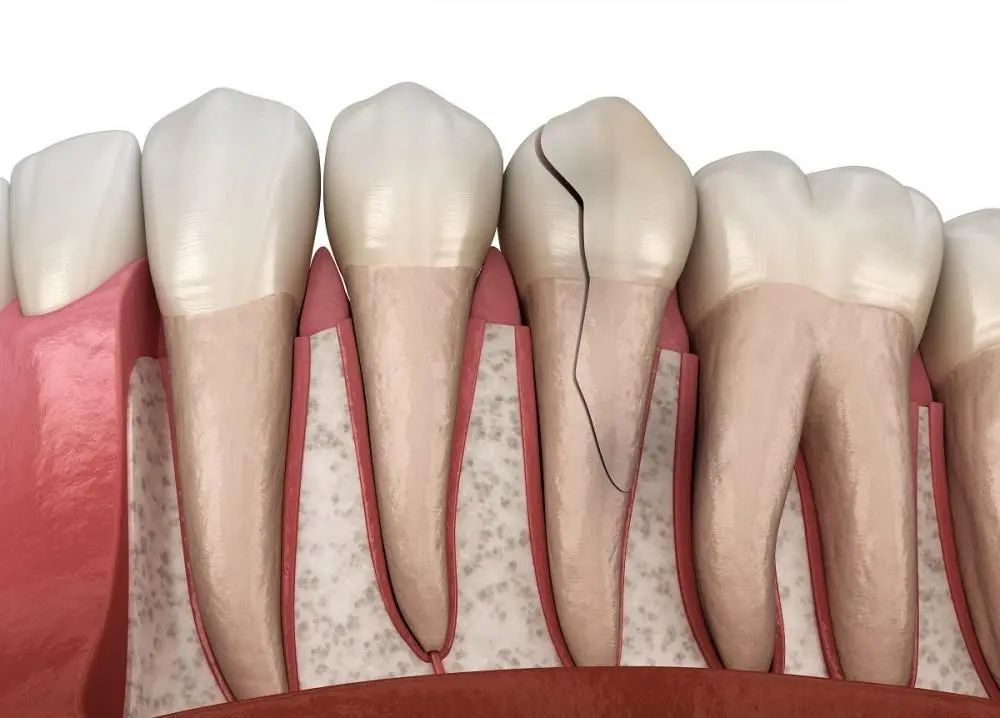
What Is Cracked Tooth Syndrome?
Cracked Tooth Syndrome (CTS) is a condition in which there is an incomplete fracture in a tooth, most commonly a back tooth, without the tooth splitting into two separate pieces.
These cracks are often extremely fine (hairline fractures), making them invisible to the naked eye and frequently undetectable on standard 2D X-rays. As a result, many patients present with complaints of tooth sensitivity without cavities, even though no large decay is found during examination.
CTS most commonly affects molars, as they endure the greatest chewing forces.
Key Symptom: Sharp Pain When Biting
Cracked Tooth Syndrome has a characteristic pain pattern that differs from ordinary cavities.
Common symptoms include:
Sharp pain when biting into food
Pain that occurs when releasing biting pressure (rebound pain)
Sensitivity to cold food or beverages
Intermittent tooth pain that comes and goes
No visible large cavity
The pain is often localized to a specific tooth but can be difficult for patients to describe precisely. Because there is no obvious decay, CTS is frequently mistaken for simple tooth sensitivity.
Why Is the Crack Difficult to Detect?
In its early stages, the crack is typically very small and does not fully separate the tooth structure.
At this stage:
The crack often does not appear on conventional 2D radiographs
The fracture line is extremely thin and hidden within enamel and dentin
To aid diagnosis, dentists may perform:
Bite tests to identify the exact painful cusp
Transillumination (light testing) to reveal fracture lines
Examination under magnification or with a dental microscope
Special staining techniques in certain cases
CTS is primarily a clinical diagnosis, meaning it is determined based on a combination of symptoms, history, and detailed examination findings.
Causes and Risk Factors
Several factors increase the risk of developing Cracked Tooth Syndrome:
Bruxism (clenching or grinding teeth)
Large existing fillings that weaken tooth structure
Chewing excessively hard foods or objects
Excessive biting pressure on posterior teeth
Chronic or repetitive stress on teeth, especially in patients who grind their teeth during sleep, is a leading contributor to microcracks.
Why Early Treatment Is Important
If left untreated, a crack can deepen and eventually reach the pulp (the tooth nerve).
This may result in:
Pulp inflammation (pulpitis)
Pulp necrosis (death of the tooth nerve)
Progression into a split tooth, where the tooth completely separates
The deeper the crack extends, the more complex the treatment becomes.
How Is Cracked Tooth Syndrome Treated?
Treatment depends on the depth and extent of the fracture:
Minor cracks → Adhesive restoration or filling to reinforce the structure
Deeper cracks that weaken cusps → Onlay or dental crown to protect the tooth
If the pulp is involved → Root canal treatment followed by a dental crown
The primary goal of treatment is to prevent further crack propagation, relieve pain, and preserve as much natural tooth structure as possible.
Conclusion
Cracked Tooth Syndrome is a common cause of tooth sensitivity without visible cavities, particularly when pain occurs during biting and upon release of pressure.
Because cracks often do not appear on standard X-rays, the condition can be difficult to identify without careful clinical evaluation.
Early diagnosis is crucial. The sooner a crack is stabilized, the greater the chance of preserving the tooth and preventing more serious complications.
If you experience recurring sharp pain in a specific tooth without a clear cavity, do not ignore it. A timely examination may save your tooth before the condition progresses.
References
Li, F., Diao, Y., Wang, J., Hou, X., Qiao, S., Kong, J., Sun, Y., Lee, E. S., & Jiang, H. B. (2021). Review of Cracked Tooth Syndrome: Etiology, Diagnosis, Management, and Prevention. Pain research & management, 2021, 3788660. https://doi.org/10.1155/2021/3788660
Yu, M., Li, J., Liu, S., Xie, Z., Liu, J., & Liu, Y. (2022). Diagnosis of cracked tooth: Clinical status and research progress. The Japanese dental science review, 58, 357–364. https://doi.org/10.1016/j.jdsr.2022.11.002
Zhang, S., Xu, Y., Ma, Y., Zhao, W., Jin, X., & Fu, B. (2024). The treatment outcomes of cracked teeth: A systematic review and meta-analysis. Journal of Dentistry. Advance online publication. https://doi.org/10.1016/j.jdent.2024.104843